
What Bartow County Deed Records Convey
A recorded deed does several jobs at once. It names the grantor and grantee, describes the land, and fixes the instrument's place in the Clerk of Superior Court's real-estate records. What the deed actually conveyed depends on its language. Security deeds, liens, releases, plats, and lis pendens sit beside deeds in the same records, yet each does different legal work.
| Deed Type | What It Does | Common Use |
|---|---|---|
| Warranty deed | Conveys the stated estate with warranties | Ordinary sale |
| Quitclaim deed | Conveys whatever interest the grantor has | Family or title cleanup |
| Limited-warranty deed | Provides narrower promises | Some entity sales |
| Executor deed | Transfers through an estate representative | Probate disposition |
| Tax deed | Records a tax-sale transfer | Delinquent-tax property |
A deed proves transfer. A security deed or lien is only an encumbrance. Check the indexed document type before assuming a party-name hit changed ownership.
Bartow QuickLink Opens the Historic Index
The Clerk's Bartow QuickLink reaches back surprisingly far. It covers deeds from 1837 through 1975. A Numerical Land Index covers 40- and 160-acre tracts, and plats run from 1942 through 1989. Searches can be narrowed by party type, last or company name, first name, instrument type, book, page, and a recording-date range.
| Party and name | Find grantors, grantees, people, estates, and companies |
|---|---|
| Instrument type | Narrow deeds from other recordings |
| Book / page | Retrieve a known reference |
| Date range | Limit a broad name search |
The official QuickLink screen displays these named collections.
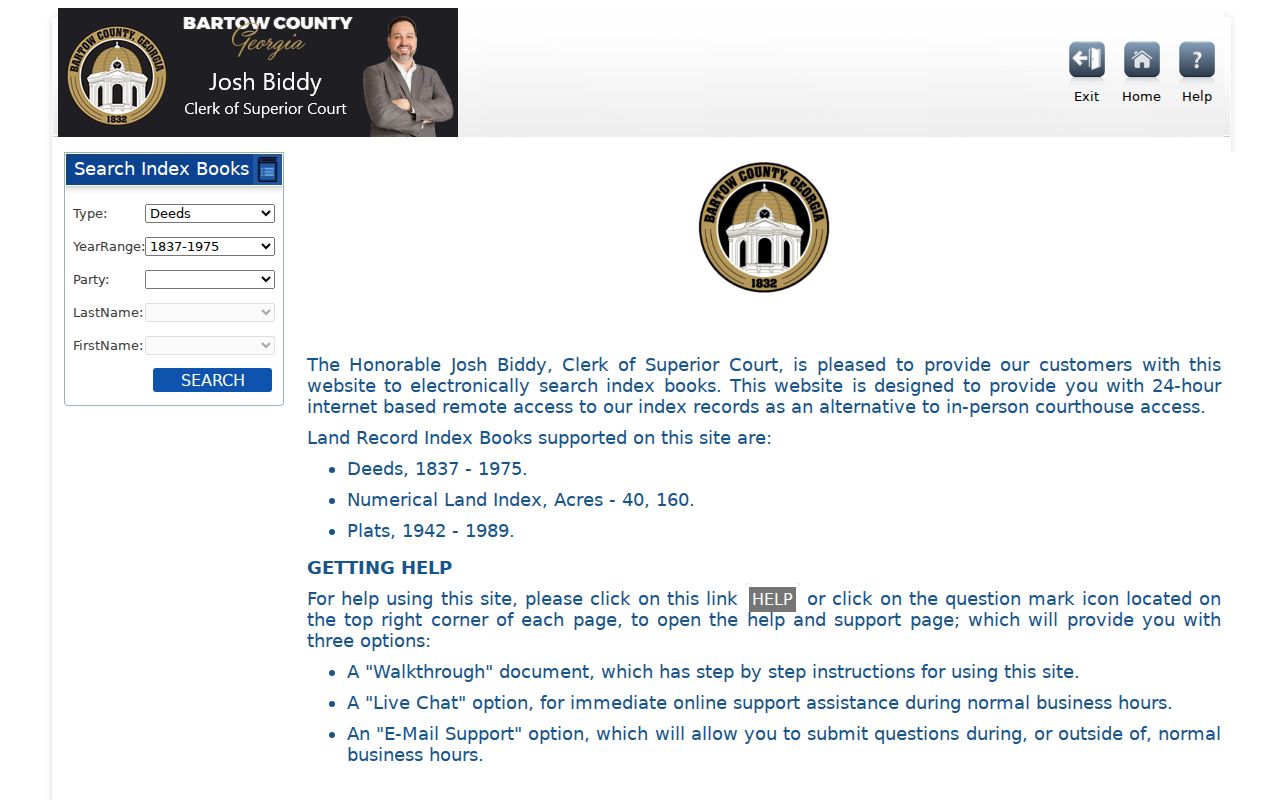
Images are not always available. Save the query and book/page details anyway, then ask the Real Estate Division about counter or copy access.
Follow Bartow's Grantor-Grantee Trail
The index runs on party names, not modern addresses. Start from the current owner's acquisition, verify the land description, and let the named seller point to the next step back.
- Find the current owner's acquiring deed with that owner as grantee.
- Read the grantor, date, deed type, and recording reference.
- Search the grantor as an earlier grantee and match the land description.
- Repeat to the online cutoff, then use deed books or microfilm.
- Grantor
- The party conveying the interest.
- Grantee
- The party receiving it.
- Chain of title
- The connected sequence of transfers for the same land.
- Book/page
- A deed-book location; an instrument number is a separate identifier.
Use GSCCCA for Newer Indexing
For newer filings, the Georgia Superior Court Clerks' Cooperative Authority offers statewide real-estate, lien, plat, PT-61, and UCC searches. Treat it as its own route rather than an extension of QuickLink, since image coverage for every Bartow filing is not assured. The official search menu lists each record family.
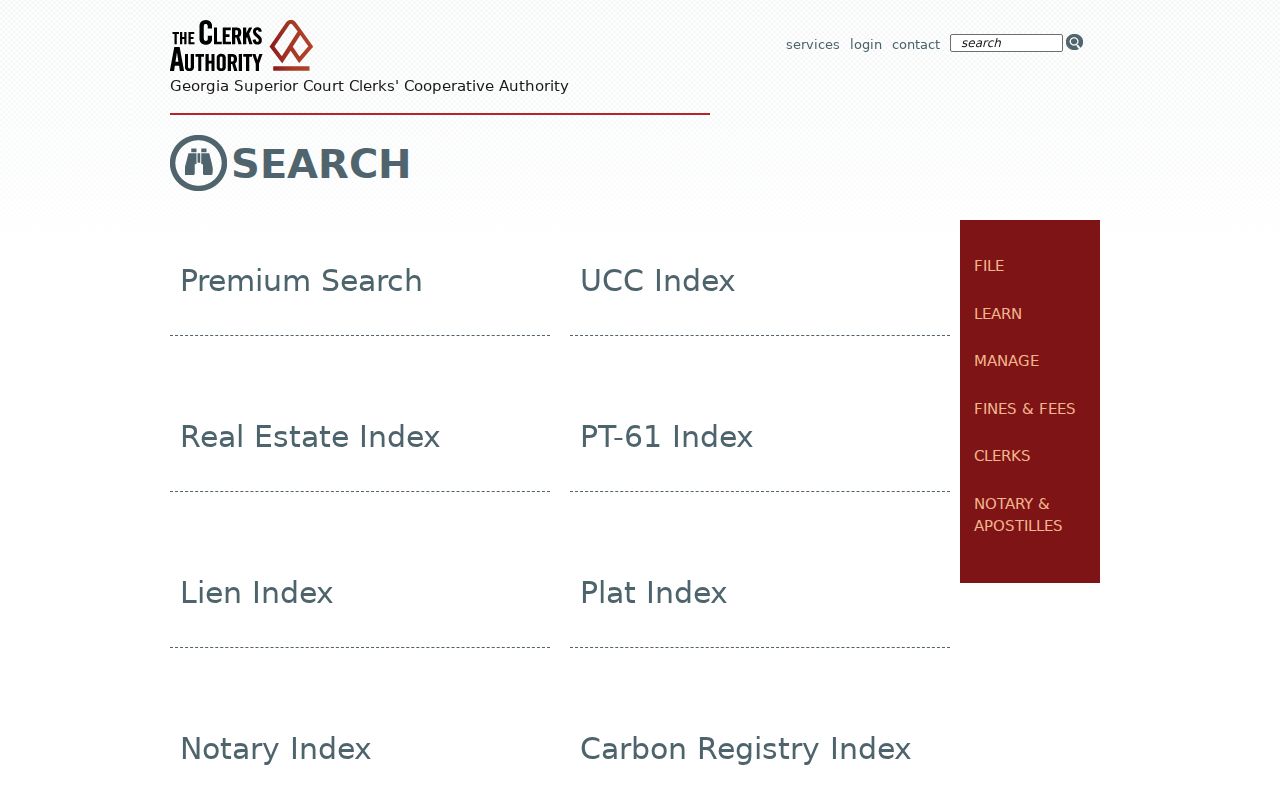
Pick the right record family first. A plat or lien may explain the property but is not the transfer deed.
Search Cass County for Early Deeds
Bartow began as Cass County in 1832 and took its current name in 1861. Cassville's courthouse burned in 1864, and Cartersville became the county seat in 1867. Early deeds may be indexed under Cass, Cassville, districts, and land lots, so assume nothing was destroyed without confirmation. The Etowah Valley Historical Society holds deed, mortgage, and grantor-grantee microfilm for 1837-1902, plus an 1838 land-lottery map. Its courthouse office offers an offline research channel. The Bartow History Museum vertical files add digitized land and deed material.
Match the Deed to the Plat
Before linking two transfers, compare district, land lot, acreage, subdivision, lot and block, and metes-and-bounds language. QuickLink's plat collection spans 1942-1989, and GSCCCA offers another plat-search path. The parcel maps guide shows how current GIS geometry helps locate a tract without legally establishing it. Cartersville's four local historic districts, designated between 2004 and 2010 and covering roughly 625 properties, show why an overlay map adds context yet never replaces the recorded deed or plat.
Watch for Future Georgia Filings
Georgia FANS notifies enrolled users about certain indexed real-estate and personal-property filings. The service looks forward only. It is not guaranteed comprehensive, and there is no separate Bartow alert. The Georgia Attorney General's title-theft guidance describes identity-validation changes effective January 1, 2025. The official FANS page explains enrollment.
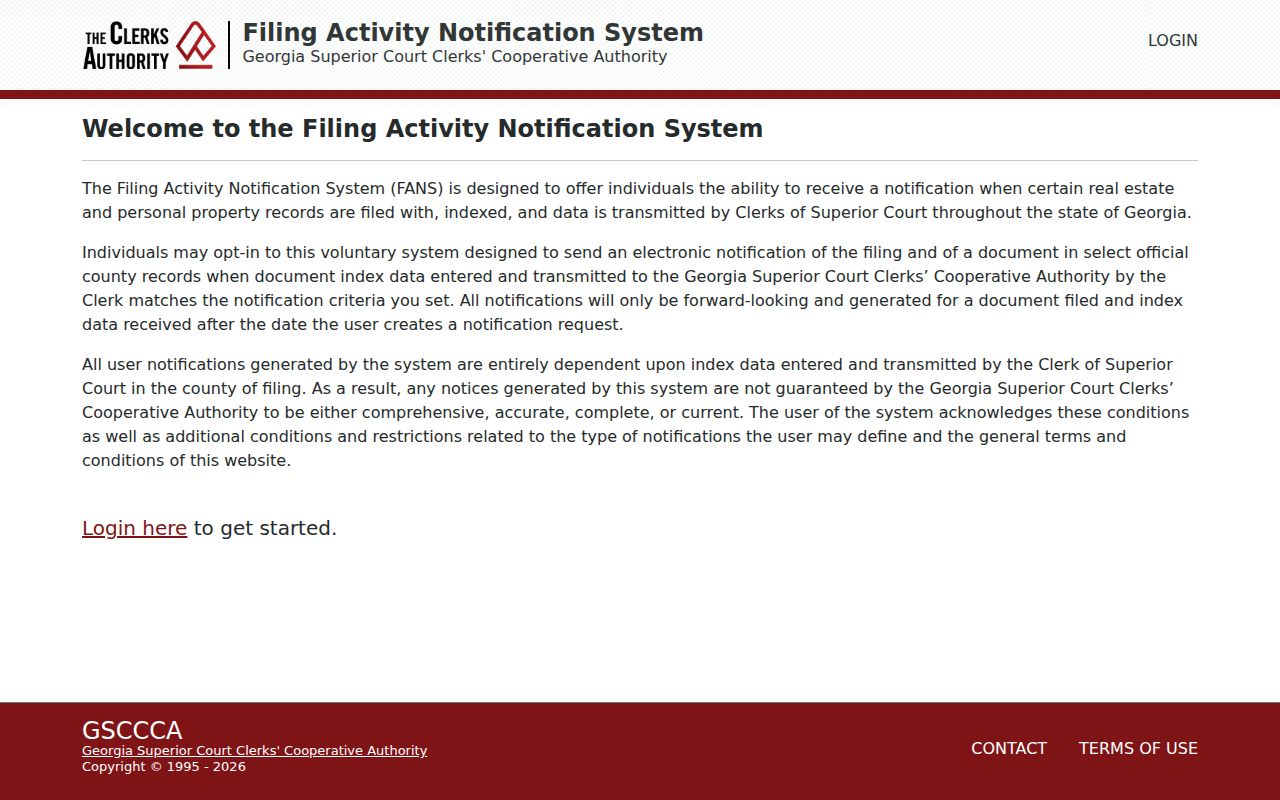
An alert is a prompt, not proof. Inspect the filing with the Clerk before treating it as valid.
Use Every Bartow Deed Access Channel
Online searching opens only the first channel. QuickLink supplies a defined historic index, while GSCCCA supplies statewide search categories. The Clerk's counter still matters for staff-assisted index questions, public terminals, image gaps, and certified copies. A mail request should identify a specific document. It should not ask staff for open-ended title research. When an old chain outruns usable digital images, turn to physical deed books, microfilm, and the Etowah Valley Historical Society holdings. A focused request under the Georgia Open Records Act can seek an identifiable existing record. The Act never obligates the Clerk to assemble a new chain-of-title report, though.
Recognize Estate and Trust Detours
A chain can look like it dead-ends. That happens when title passes through an estate, trustee, corporate entity, or court proceeding. Search the full legal entity along with abbreviations, initials, and representative capacity. An executor's or administrator's deed may name an estate. It may not match the person a tax card suggests. Probate records explain who held authority; the deed still documents the recorded conveyance. Compare the legal description at every step. One person may own several Bartow parcels. A name match alone cannot tie two instruments to the same tract. For digging deeper into prior holders, the backward-chain guide keeps the focus on time depth.
Review Every Bartow Index Hit
A careful deed-record log pays for itself. Record the party role, exact spelling, instrument type, recording date, book and page, and any visible land-description clues. The newest hit under an owner name might be a lien, a release, or a corrective instrument. It could also be a deed for another parcel entirely. Confirm district, land lot, subdivision, acreage, or adjoining calls before adding anything to the chain. Keep the unsuccessful name variants too. A company may be indexed with or without punctuation. A trust may appear under its trustee, and an estate can surface under the decedent or a representative. Initials matter in older books. An overly narrow date range can hide a late recording.
Suppose two candidate deeds survive your Bartow County search. Compare the acreage and plat references on each against the assessor card. Also ask whether the image has a continuation page or an exhibit. The legal description may not appear on the first page, so a full copy matters.
Tell the difference between a plain image and a certified copy. The plain one supports personal research. The certified one carries the Clerk's certification for any use demanding an official deed record. When ordering, state the format you need. Confirm the current charge. Keep the receipt with its recording reference.
Get a Bartow County Deed Copy
An online image is the place to start. If an image is missing or you need certification, contact the Bartow County Clerk's Real Estate Division with party names, document type, date, and book/page. The county posts a fee schedule effective July 1, 2024, and you should verify the current amount before paying. Counter access handles index questions well. A focused mail request or a Georgia Open Records Act request can reach an identifiable existing record. Staff are not required to create a title abstract.
Recorded, not guaranteed. Bartow County deed records show filed instruments, but an index entry is not a title opinion and may not disclose unrecorded interests.
Build a Defensible Bartow Deed File
Organize every Bartow deed hit before you move to the next name. Copy the indexed grantor and grantee exactly as written. Note the instrument type and the recording date. Note the book/page or instrument number too. Note each land-lot, district, subdivision, and lot reference. Preserve spelling variants. An entity may be indexed under initials, a trust name, or an older corporate style. An estate transfer may name an executor or administrator instead. This is why a plain surname search can miss the next link in the chain.
Check the index entry against the image or copy whenever one exists. The index is a finding aid, not the instrument. The deed text can reveal reservations, easements, prior deed citations, plat references, and consideration language. It can also reveal a legal description the result grid never shows. Follow each cited prior deed by book/page. Then test the chain from both directions with the party index. A security deed, lien, release, plat, or lis pendens can shape the history without conveying anything. Label record types instead of forcing every filing into the transfer chain.
QuickLink stops at its posted 1975 deed cutoff. Continue through GSCCCA and the Clerk's current channels. For earlier years, ask about deed books, reverse indexes, courthouse access, and EVHS microfilm. Give staff a narrow request with names, an approximate year, record type, and any known citation. Georgia's Open Records Act reaches identifiable existing records. It does not force the Clerk to build a title abstract or reconstruct ownership. For a legal or closing purpose, confirm whether a certified copy is required. Verify the current fee schedule directly.
Keep your negative results too. Before changing one variable, note the spelling, party role, record type, and year range you searched. Try a married name, estate style, trustee, lender, or business entity only when another record supports that variation. For Cass-era land, lead with land-lot and deed citations rather than a modern address in a party index. This method gives courthouse staff a clear starting point.