
Trace Back Through Bartow County's Transfer Record
Start with the newest matching transfer. Then work toward the deed. It shows how each grantor acquired that same land in Bartow County. Capture the date, party names, deed type, book and page, and legal description. Keep these details as a working timeline. Not every deed in the chain is an arm's-length sale.
| Transfer date | Grantor to grantee | Deed type | Book/page or instrument |
|---|---|---|---|
| Newest match | Prior holder to current grantee | As indexed | Copy exactly |
| Earlier match | Earlier holder to that grantor | As indexed | Follow cross-reference |
| Plat event | Developer or dedicator as shown | Recorded plat | Plat book/page |
| Estate event | Executor or administrator to grantee | Estate-related deed | Deed and probate clue |
Never fill a gap with a guess. A quitclaim deed can release an interest without any sale taking place. A security deed only encumbers the land. It does not change the fee owner of record.
Go Back Through Bartow QuickLink's 1837-1975 Window
The Bartow Clerk QuickLink searches by Type, YearRange, Party, LastName, and FirstName. Coverage runs from 1837 through 1975 for deeds. Plats span 1942 through 1989. That window makes QuickLink a strong historic route. It is not a complete current deed archive, and the official page shows why former-owner research leans on party and year rather than a modern street-address field.
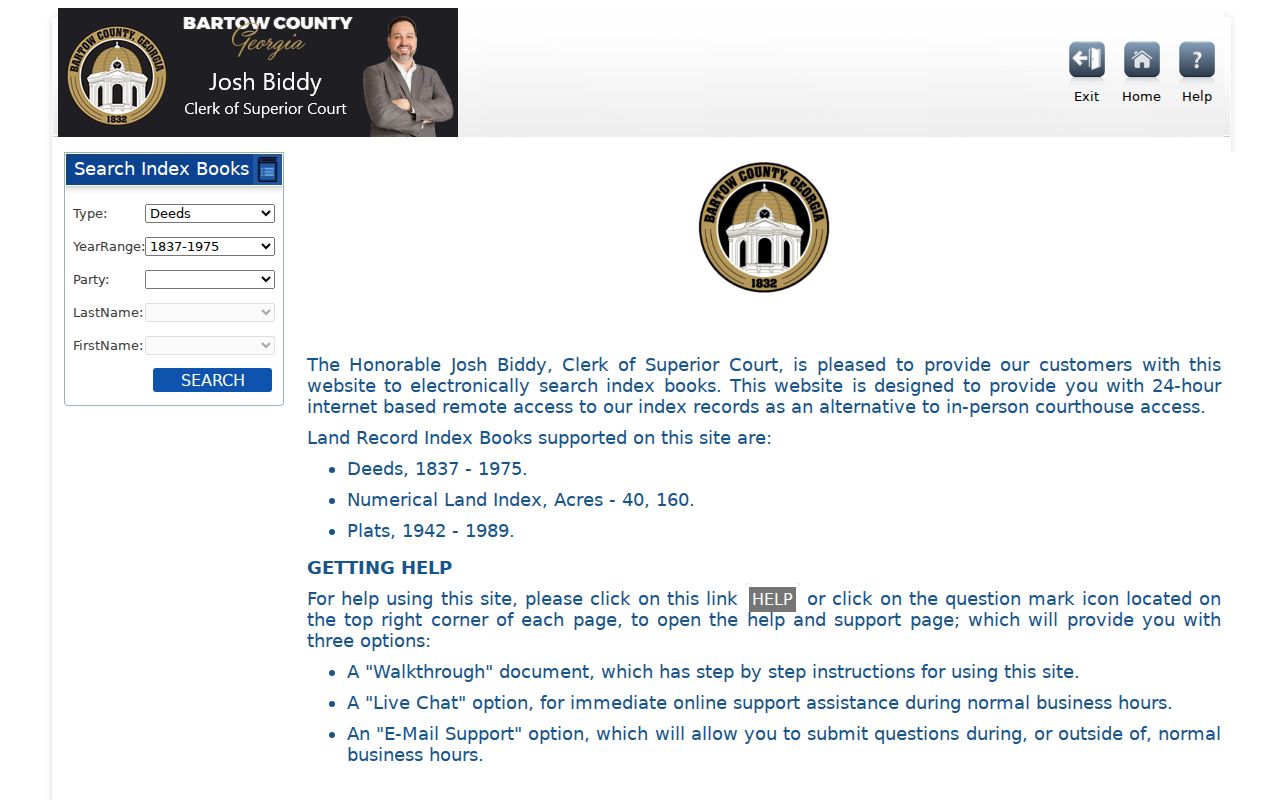
When a chain crosses 1975, record the last QuickLink hit and continue through GSCCCA or the Clerk. The cutoff changes the access tool, not the ownership.
Choose the Bartow County Ownership Source by Era
Bartow County former owners surface across several overlapping collections.
| Collection | Verified span | Access point |
|---|---|---|
| QuickLink deeds | 1837-1975 | Remote historical index |
| EVHS deed/mortgage and party indexes | 1837-1902 | Courthouse-office microfilm |
| QuickLink plats | 1942-1989 | Remote historical index |
| EVHS tax digests | 1871-1899 | Microfilm research aid |
| DLG legal vertical files | Mostly 1850s-1929 | Digitized museum files |
EVHS microfilm is a research aid only. Note the roll, volume, and page, then ask the Clerk where a certifiable record of the deed is held.
Reconstruct Bartow County's Deed Chain in Reverse
The reverse method relies on one identical parcel description. The parcel description must match at every step. A party-name match without the right land lot, district, subdivision, lot, acreage, or plat reference stays outside the deed chain until proved otherwise.
- Find the current grantee's acquisition deed and record its legal description.
- Read the grantor, then search that party as an earlier grantee.
- Compare the next deed's description and references before adding it.
- Repeat through GSCCCA, QuickLink, deed books, or microfilm as the date requires.
- Grantor and grantee
- The transferring and receiving parties named in a deed.
- Chain of title
- The linked sequence of instruments affecting ownership.
- Reverse index
- An index used to find a party on the opposite side of a transfer.
- Warranty and quitclaim deeds
- Different forms whose legal effect must be read from the instrument.
Search Cass Before Reconstructing Early Bartow Owners
Bartow County formed from Cherokee County in 1832 under the name Cass County, then took the Bartow name in 1861. Cassville served as the original county seat. It burned during the Civil War, and Cartersville became the seat in 1867. Those facts reshape any early property search. Try both Cass and Bartow alongside land lot, district, road, creek, landmark, and party name. Cassville's burning does not mean deed books were lost. No official list documents any destroyed deed series. Note: County-name and seat changes alter indexes and custody clues, but they never justify inventing a gap in a former-owner chain.
Align Bartow County Former Owners with Old Maps
EVHS catalogs an 1838 land-lottery map, an early-1840s downtown map, and Sanborn maps from 1885, 1889, 1900, 1909, 1916, and 1923. Old maps help. They turn old clues into deed-book searches. The Clerk's recorded plat remains the stronger subdivision reference. The EVHS inventory also lists newspapers, homestead records, tax digests, and court books. A directory or legal notice may suggest a prior owner in a given year, but confirm every transfer in the deed itself.
Continue a Bartow County Chain Off the Web
The EVHS courthouse office holds more than 400 volumes. Microfilm readers and copying are available. Volunteer hours apply, so call 770-606-8862 before visiting. Georgia Archives finding aids identify Bartow deed, bond, and lease indexes for 1910 through 1927. A finding aid proves a collection exists. The Clerk's office is at 135 W. Cherokee Avenue, Suite 233, Cartersville, with phone 770-387-5025 and email clerksoffice@bartowga.org. Not every file is online, so ask whether an item sits at the Clerk, the archive, or EVHS and request its exact volume, page, roll, or box reference.
Resolve Bartow County Estate and Lien Detours
Estates send many chains down a detour. An executor's deed, administrator's deed, deed of distribution, deed under power, or order can carry title. So can an affidavit. Search the deceased owner and estate wording. Check Probate Court records whenever a deed points to a proceeding. Probate Court can be reached at 770-387-5075, and it publishes no online estate portal. Mortgages, assignments, releases, liens, and lis pendens belong on a separate instrument trail. They can explain a transfer. Keep the trails separate. Hold a lender or claimant out of the former-owner timeline unless a transfer instrument names it as grantee.
Keep a Bartow County Former-Owner Research Log
A research log keeps surnames off the wrong tract. Log every candidate separately. For each, write the searched name, role, year range, instrument type, book and page or instrument number, execution and recording dates, and the exact land description. Note the source too. Say whether you reviewed an image. Record any cross-reference to a prior deed or plat, and mark uncertain rows rather than quietly folding them into the chain.
Parcel identity shifts over time. Splits, combinations, rights-of-way, subdivision recordings, and revised street addresses all change it. An old description may cover a larger parent tract. Trace the later out-conveyances before claiming that every former owner held today's exact parcel. Land-lot and district references outlast street names. A plat book and page can bridge the parent tract to a numbered lot in Bartow County. The assessor parcel number bridges lot to present map. Tax digests, newspapers, directories, maps, and probate files can surface names and dates. Keep them labeled as supporting clues, because the deed sequence remains the parcel-facing trail, and when the history affects legal rights, a certified record or title examination may be needed.
Test Each Bartow County Prior Owner Against the Land
A run of matching surnames proves nothing on its own. Every row needs a property match. Compare each deed's land lot and district, subdivision and lot, acreage, metes-and-bounds calls, and plat reference against the instruments before and after it. Grantors often owned several tracts. An index hit under that name may belong to different land entirely. A part-conveyance from a parent tract breaks the line too, since the modern parcel may not inherit the full parent history in a tidy one-to-one sequence.
Dates need labels as well. Execution, recording, assessment, probate filing, and newspaper publication dates can all differ. Anchor the public transfer on the deed recording reference. Then use tax digests or notices to corroborate the relevant year. An obituary, directory item, cemetery notice, or court allegation can offer a clue. It cannot replace the recorded transfer.
Source quality deserves its own mark. A QuickLink or GSCCCA index hit merely points to an instrument. A reviewed deed image supplies the actual terms. EVHS microfilm or an abstract can guide the work, while a Clerk-certified copy serves as the official document when a legal need arises, and this hierarchy keeps a house-history narrative honest about where gaps remain.
How Far Back Bartow County Former Owners Can Be Traced
Bartow County deed and party-index records reach back to 1837, the county's founding era. That start date is not a promise. No single online chain covers every parcel. Land-lottery evidence, shifting land descriptions, parcel splits, combinations, and estate transfers can all demand expert handling, and a title examiner must weigh the full chain and its exceptions whenever legal rights turn on the answer.
Online limit. QuickLink deeds stop at 1975, while older research also lives in books and microfilm. A web cutoff is not proof that a transfer is absent.
Put former-owner research to honest uses: house history, estate work, and lawful property diligence. Never use it to stalk or harm anyone.