
Compare the Value Types in Bartow County Records
Bartow County assessment notices use two different value figures. The fair-market amount reflects what the assessor believes the property is worth, while the assessed figure applies the county's ratio to that estimate. A sale price, by contrast, comes straight from the deed when a transfer record includes it. That number is a fact about one transaction. It is not the assessor's current opinion of value.
| Value type | Meaning | Official record |
|---|---|---|
| Fair-market value | Assessor's full-value estimate for the digest | Assessment record or notice |
| Assessed value | 40% of fair-market value under Georgia law | Assessment record or notice |
| Taxable value | Assessment after applicable exemptions or adjustments | Tax assessment and bill records |
| Last sale or consideration | Amount tied to a past transfer, not today's appraisal | Deed or transfer record when shown |
Comparing numbers in Bartow County records takes care. The assessed value sits at 40 percent of fair-market value, so lining it up against a full sale price exaggerates any difference. Exemptions add another wrinkle. They reduce taxable value but leave the fair-market estimate itself untouched.
Understand Bartow County's Current and Prior Values
A Bartow County assessment notice carries more than numbers. An older example shows current and prior fair-market value. It also shows the 40 percent assessed figures for both years, a returned value, and a stated reason for the change. The form lists the owner of record and mailing address. It also gives the map and parcel number, account number, land lot, district, and subdivision or lot description. Those parcel identifiers matter. They tie each figure to the right piece of land in the property records.
Treat the older example as a vocabulary lesson. It does not guarantee that every label still appears the same way on a live assessment card today. Read the current record as the county displays it. A reason-for-change field can clarify why two digest years differ. But it is not a private appraisal report.
Calculate What Bartow County's 40% Figure Means
Georgia law fixes the rule. Assessed value equals 40 percent of fair-market value across the state, including Bartow County. When the assessor revises the fair-market estimate, the assessed figure moves with it before any exemptions or tax rates apply. Millage rates then work on that amount. Changing the millage never changes what assessed value means.
- Fair-market value
- The assessor's estimate of full value for the tax digest.
- Assessed value
- Forty percent of fair-market value in Georgia.
- Assessment ratio
- The relationship between assessed and fair-market amounts.
- Reassessment
- An official change to the parcel's valuation for a new digest period.
- Sale consideration
- A transaction figure that may not equal current fair-market value.
Note: An exemption trims taxable value, but the assessor's stated fair-market figure still shows its usual relationship to the 40% assessment. Exemptions shape the tax bill, not the underlying Bartow County property records.
Estimate Bartow County Property Value from the Official Roll
The assessor record works best for confirming official value fields. It will not predict a sale price. A parcel number or address search on the county tax roll pulls up the appraisal amount, the assessment year, and the owner of record, so you can read the numbers straight from Bartow County property records.
- Open the Bartow Board of Assessors qPublic route and search by address or parcel.
- Confirm the parcel, situs, land lot, district, and description before copying values.
- Record each amount with its label and year, including current and prior fields shown.
- Check the deed record separately when a past sale or consideration figure matters.
- Returned value
- The owner's reported figure where the assessment record shows it.
- Prior-year value
- A comparison point from an earlier digest, not today's market sale.
- Reason for change
- The notice label explaining an official valuation change when supplied.
Recognize the Bartow County Value Source
The official Board of Assessors website anchors every value figure in the county. Its property records link out to the Schneider parcel search for parcel-level detail.
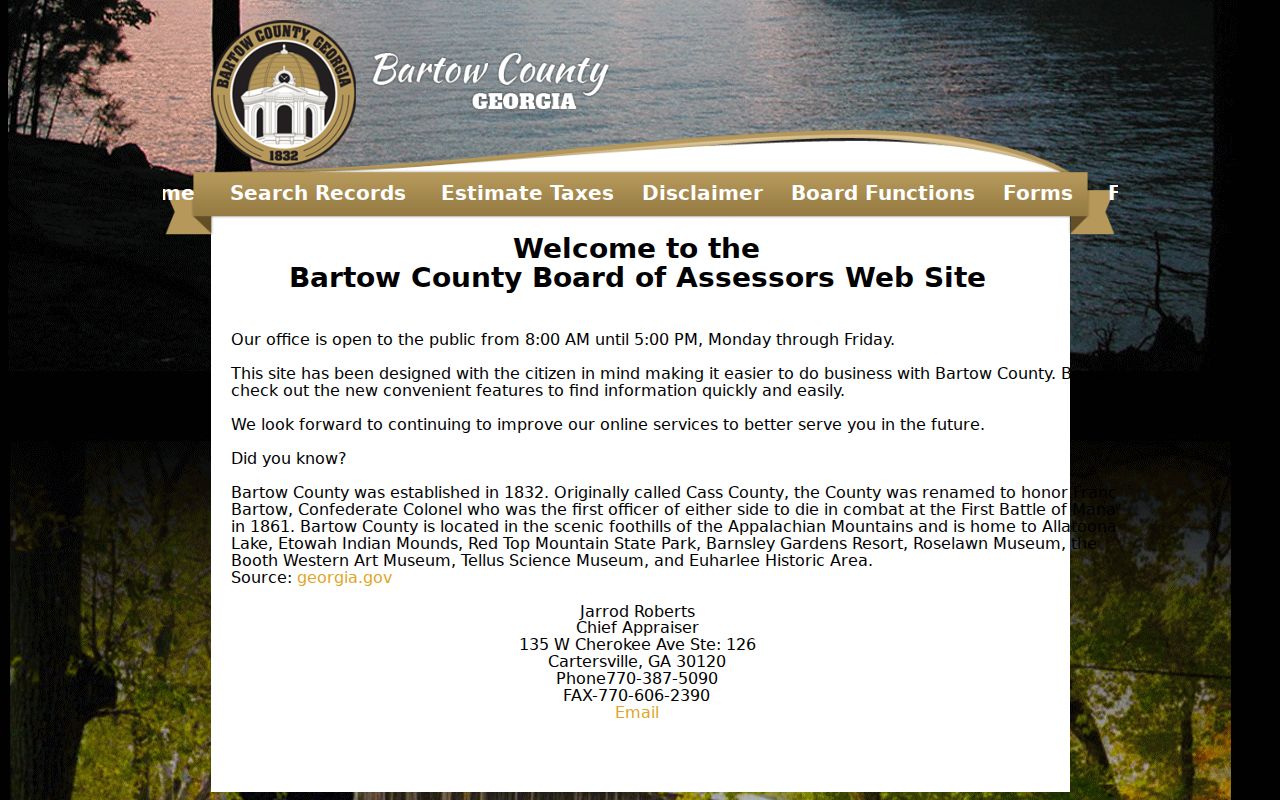
This screen shows the government source itself. The landing page only points the way; the parcel card or assessment notice is what carries the value and year worth recording from Bartow County property records.
Compare Bartow County Value at the January 1 Point
The assessor FAQ anchors its ownership and appraisal details to the January 1 tax digest. A deed recorded later will not instantly rewrite that digest. The same goes for an improvement or a market shift. Always carry the value year with you. It matters most when you weigh the roll against a recent sale. A deed can show a transfer after January 1 while the assessment still speaks for the digest period. That gap makes neither record wrong. They simply answer different questions on different dates.
Compare a Bartow County Sale with Assessor Value
Start with a search. Run the likely transaction through the GSCCCA real-estate index or the Clerk. Then match its parties and legal description to the parcel. A recorded consideration or transfer clue reflects only that one deal. It may carry unusual conditions. It does not establish what the property would fetch today. Keep the transaction date, deed type, book/page or instrument number, and legal description beside the sale figure, and never substitute the tax-roll owner or tax bill for the recorded transfer. If the deed image is unavailable, ask the Clerk's Real Estate Division for access or a copy.
Note: A last sale can be informative, but it is neither a current appraisal nor proof that an identical price would result today.
Use Bartow County GIS as Value Context, Not a Price
Bartow County's ArcGIS sources and regulations cover parcel, zoning, and flood categories. Hydro, topography, transportation, utility, and imagery map layers are included too. Those facts can sharpen questions for an appraiser. A GIS layer still cannot calculate a defensible sale value. Confirm layer dates and current availability before relying on any of them. Remember that county parcel lines are reference data, not a survey. Flood mapping makes no insurance determination. Zoning belongs with the planning office, and imagery proves nothing about current condition. Value research stays strongest when map context sits apart from the official assessment. Transaction figures deserve that same separation.
Separate Bartow County Property Value from the Tax Bill
Two offices split the work. The Tax Commissioner bills and collects, while the Board of Assessors determines assessment information. Millage, exemptions, billing status, interest, and delinquency shape taxes without redefining fair-market or assessed value. Full bill details and appeal procedures sit on the property tax records page. For a value comparison, stop at the right points. Identify the assessment year, fair-market amount, 40% assessed amount, any taxable adjustment, and separate sale evidence. That keeps a valuation question from drifting into an account-balance search.
Read Why a Bartow County Value Changed
A year-to-year change needs a constant parcel. Keep the field constant too. Compare fair-market value to fair-market value, and assessed to assessed, because mixing a 40% figure with a full-value estimate produces a meaningless gap. Once the columns line up, read any returned-value and reason-for-change fields on the current notice. Older Bartow County examples show those labels, but the live record sets the present format.
Numbers can also shift because the record itself changed. A different owner, improvement entry, parcel description, or digest year can sit behind the difference. Before drawing conclusions, confirm the map and parcel number, land lot, district, subdivision, and property description match in both periods. A split or combination makes raw comparison misleading. Watch the dates too, since a recent deed's transfer date and the January 1 digest date can land in different record periods.
Direct questions about the assessment itself to the Board of Assessors. Billing and collection belong to the Tax Commissioner. Keep those roles straight and the answer arrives faster.
Compare Bartow County Values Without Mixing Dates
Build the comparison as a simple table. Give each source its own row: assessor fair-market value with year, 40% assessed value with year, taxable value if shown, deed consideration with transfer date, and any independent appraisal with its effective date. A past sale stops posing as today's worth.
The tax bill can confirm which figures drove a billing period. Payment status never redefines value. A delinquent balance, exemption, millage change, penalty, or FiFa changes what is owed, not the assessor's full-value label. The reverse holds too. A new fair-market estimate can change assessment without any sale.
For a purchase or estate decision, say why each comparison was chosen. An appraiser weighs sales, condition, and location under professional standards. That work follows its own rules. The Bartow County parcel record supplies a documented government figure and history. It cannot deliver a current market opinion alone.
Understand What Bartow County Property Value Cannot Prove
The assessor's figure exists for the tax system. It does not promise a sale price, grade a building's condition, or settle a boundary dispute. It also cannot replace a licensed appraisal. A buyer, seller, lender, court, or estate may need a valuation prepared for one effective date and one stated purpose.
Value is not sale price. Bartow County assessed value is a tax figure at 40% of fair-market value. It is not what the property will sell for and is not an appraisal.
When the decision turns on current market value, call a Georgia-licensed appraiser. Bring the parcel number, the deed, and the physical facts. The public record supplies inputs, not the final opinion.